Beyond Dover: What Your Support Line Actually Sounds Like From Overseas
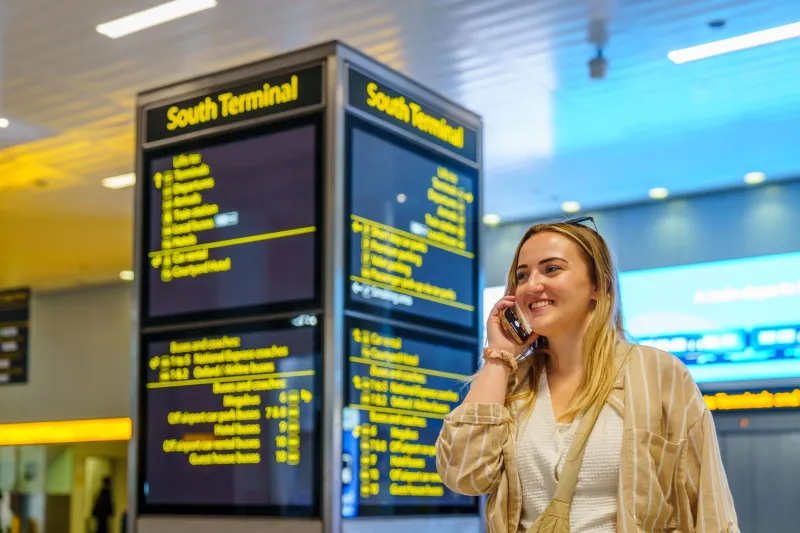
Picture the scene. A bloke in a bucket hat is standing in the passport queue at Alicante, phone in one hand, your order confirmation in the other. Your number is right there in bold at the bottom of the email. He taps it. Nothing. He types it in manually. Still nothing. He tries again with a plus sign in front, because his nephew once told him that was a thing. Now he's cross, the queue is moving, and your support team has no idea any of this happened.
None of that is really his fault, and it isn't yours either. It's just that British phone numbers were designed for Britain, and international dialling has never been especially sentimental about that.
The bit nobody puts in the welcome email
Freephone is a domestic promise. When you advertise an 0800 number, what you're really advertising is an arrangement between your business and UK networks: the caller pays nothing, you pick up the tab. That arrangement stops existing the moment the call originates on a foreign network.
So what happens? It varies, and that's the maddening part. Some overseas operators simply won't carry 0800 traffic at all — the call fails before it rings. Others will connect it, but only by treating it as an international call and charging the caller by the minute. A few will connect it cleanly and charge a fortune anyway. The person on the other end has no way of knowing which of those three they've walked into until the call either connects or dies.
03 numbers: built for Britain, not for Benidorm
03 numbers were meant to be the sensible modern answer — the same cost as calling a normal UK landline, no nasty premium surprises. From inside the UK, that holds up nicely. From outside it, things get wobbly.
Yes, +44 3xx technically exists. But plenty of foreign carriers decline to complete those calls, because there's no neat international settlement rate for a number range that was invented to be cheap at home. Others will put it through without complaint. Spain is generally fine, parts of the US are a coin toss, and a prepaid SIM in rural Portugal may simply stare at you. It's a lottery, and your customers are the ones buying the tickets.
And then there's 084 and 087
Service numbers — 0843, 0844, 0845, 0870, 0871 and friends — are effectively invisible from abroad. Most international networks won't touch them, and the ones that do will charge accordingly. If your only route to a human is an 0844 number, you should assume that route does not exist for anyone outside the UK. Add in the fact that these ranges are already a source of quiet grumbling at home, and there's a decent argument for retiring them altogether.
What to publish instead
The reliable option is a plain geographic number: an 01 or 02 landline with a proper area code. Foreign networks understand them, they terminate normally, and the caller pays a standard international rate rather than a mystery sum. It doesn't need to be a second phone system — a simple divert from the landline to your existing hunt group does the job.
A UK mobile works too, though it's pricier for the caller. And for anything that isn't urgent, don't forget the channels that ignore borders completely: email, web chat, WhatsApp, or a callback booked for a sensible hour.
How to word it so nobody gets lost
A small block of text, repeated wherever your number appears, does most of the work:
Calling from outside the UK? Our 0800 and 03 numbers only connect from UK networks. Please dial +44 20 7946 0958 instead, or email [email protected] and we'll come back to you.
Put that next to the number in your site header, on the contact page, in the footer, at the bottom of order and booking confirmations, in ticket auto-replies, and on invoice templates. It's cheap, it's boring, and it saves an astonishing number of annoyed emails.
While you're there, spell out the dialling format. Drop the leading zero, keep the plus: 020 7946 0958 becomes +44 20 7946 0958. Say it once, plainly, because half your customers will be reading it at 11pm in a hotel corridor.
And mention time zones. Your opening hours are in UK time, which is GMT in winter and BST in summer — a subtlety that confuses everybody, including plenty of Brits. A short line like "9am–5pm UK time" plus a link to a time zone converter is plenty.
The Wi-Fi calling wrinkle
One curious exception: a UK customer abroad, connected to hotel Wi-Fi and using Wi-Fi calling on their UK SIM, will sometimes get through to an 0800 number exactly as if they were sitting in Leeds. Sometimes. It depends on the network, the handset and the phase of the moon. Lovely when it happens — just don't build your support process on the assumption that it will.
Test it before the holiday rush
- Borrow a phone abroad. A colleague in Dublin, a cousin in Malaga, a travel SIM with voice minutes — any of these will do. A data-only eSIM won't help, since it can't make calls.
- Ring every number you publish, including the fallback landline, and note exactly what happens: rings, fails, or connects with a recorded message.
- Check your IVR. If the greeting invites overseas callers to "press 1 for sales", make sure pressing 1 actually works from a foreign network.
- Listen to your own voicemail greeting and out-of-hours message. Do they mention the overseas route? If not, re-record.
- Repeat the test on a UK mobile roaming abroad, not just on a foreign SIM — the behaviour can differ.
- Diarise it. Numbers, networks and roaming rules all drift. A ten-minute retest twice a year beats discovering the problem from a one-star review.
Freephone is a genuinely good thing to offer. It just doesn't travel, and the sooner that's written down somewhere obvious, the fewer bucket-hatted callers you'll lose to a dead dial tone.